Restricted Access
This site is under active development.
Access denied.
Authorized personnel only
Home About Timeline Videos Documents Media The Record Jason's Story Contact
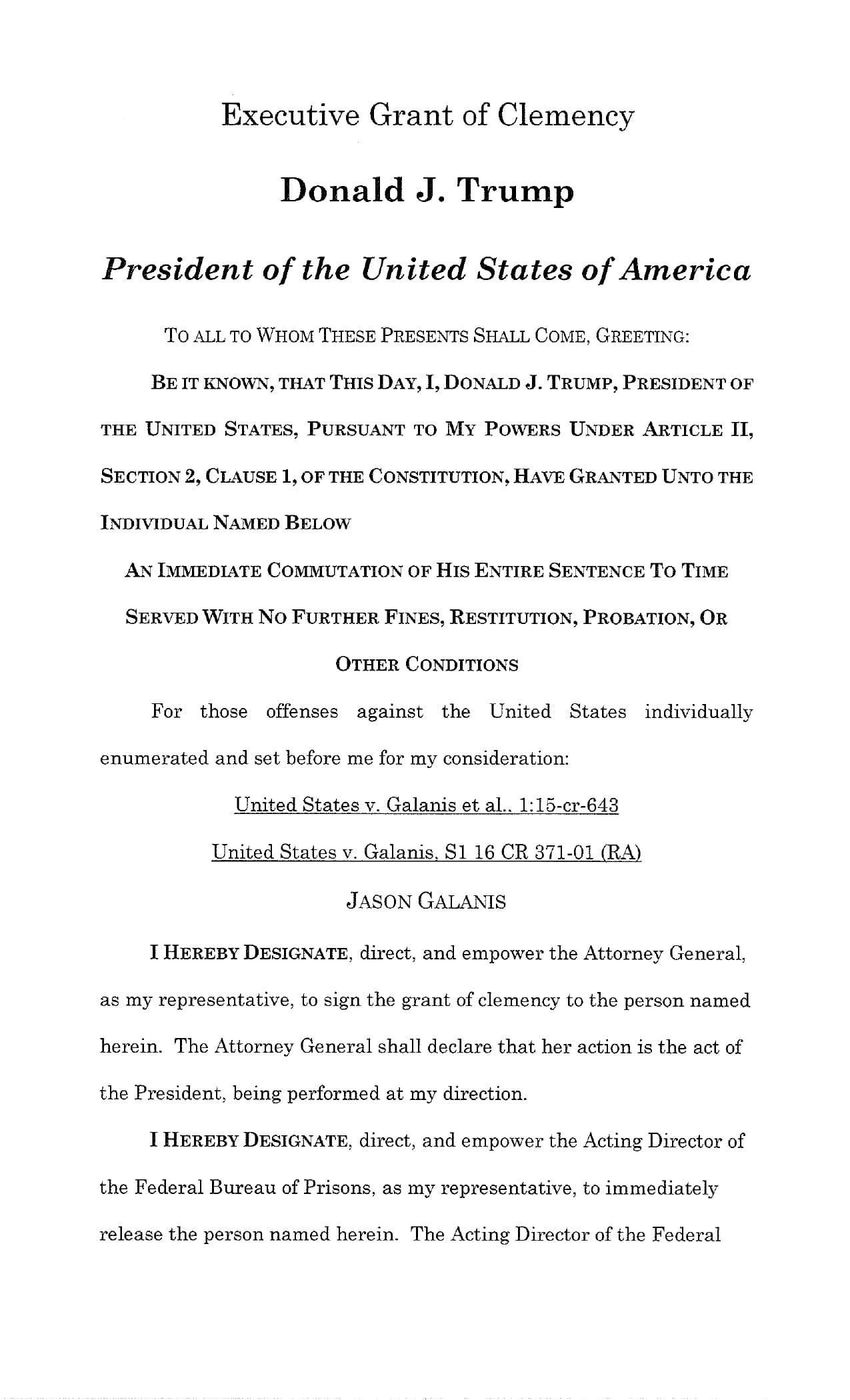
Pardoned by President Donald J. Trump
45th & 47th President of the United States
March 28, 2025
Pardoned by President Donald J. Trump 45th & 47th President of the United States
March 28, 2025
White House Quote
"[Galanis] was the fall guy for Hunter Biden and Devon Archer."
Trump administration official  ·  Fox News Digital  ·  March 28, 2025
Read on Fox News →
Judiciary Committee & Oversight Committee Chairmen
"[Galanis was] singled out for unequal treatment."
Jordan & Comer  ·  Official letter & subpoena to US Attorney Damian Williams, SDNY  ·  April 26, 2024
Read the letter →
Corrupt interference — evidenced by the SEC
Hunter Biden's lawyers wrote to the SEC: "It would be unfair, not just to our client, but also to his father, the Vice President of the United States, if his involvement in an SEC investigation and parallel criminal probe were to become the subject of any media attention."
Hunter Biden counsel letter to SEC  ·  April 20, 2016  ·  Cited in Comer & Jordan letter to SEC Chair Gensler  ·  June 18, 2024
Two tiers — evidenced by the pardon
Hunter Biden received a blanket pardon covering all acts known and unknown, backdated eleven years. Unprecedented in American history. Jason Galanis served eight years.
Presidential pardon  ·  November 2024
Great Personal Risk
"I worry about other unthinkable consequences Galanis might face as a result of my investigation. One day I hope to find whoever did this to the guy and make their life extremely uncomfortable. It's the least I can do."
Chairman James Comer  ·  All the President's Money  ·  Broadside Books / HarperCollins  ·  p. 207
U.S. House Impeachment Inquiry — 2024
Part of the Congressional Record.
Testimony. Documents. Firsthand accounts.
This is what was said — under oath.
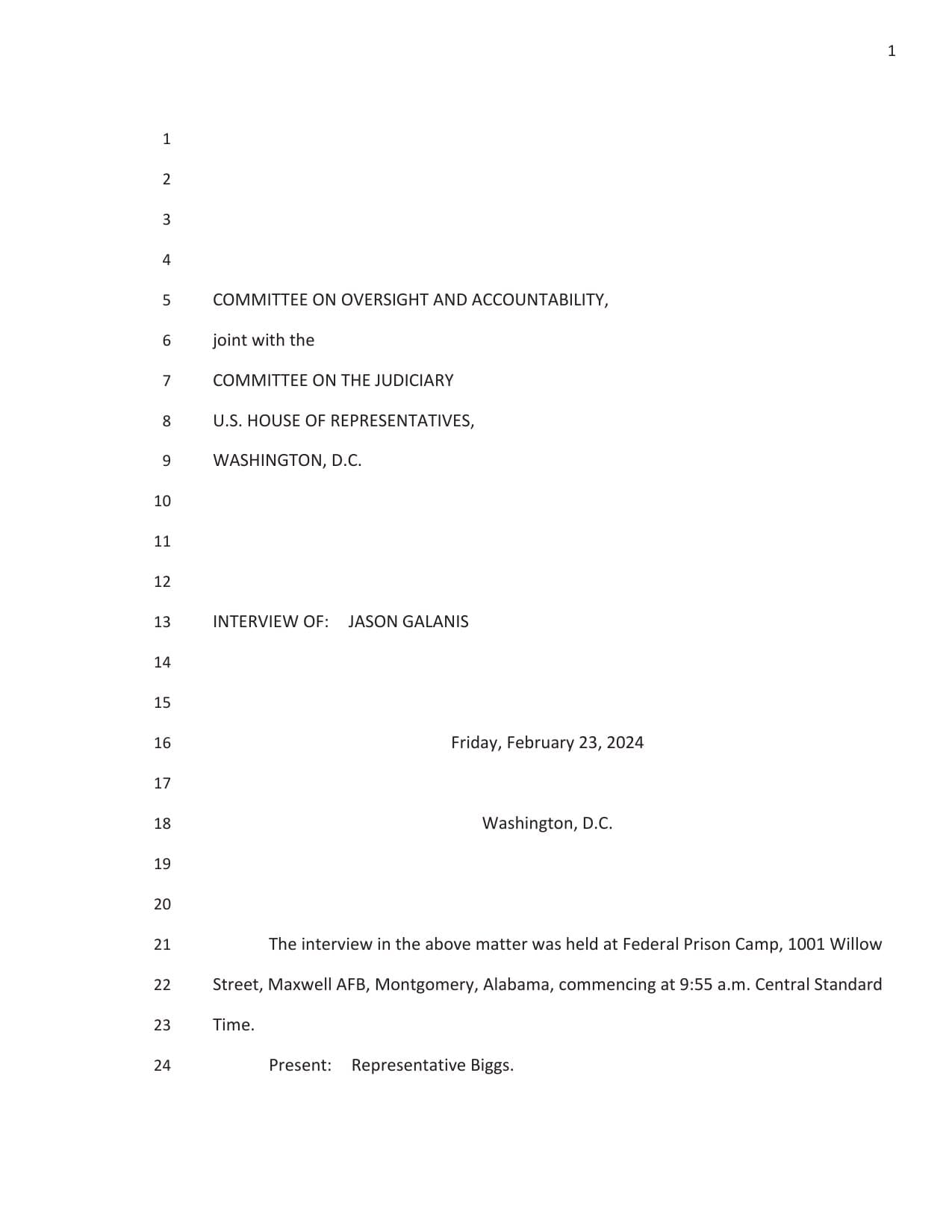
Closed transcribed interview  ·  February 23, 2024  ·  Federal Prison Camp, Maxwell AFB
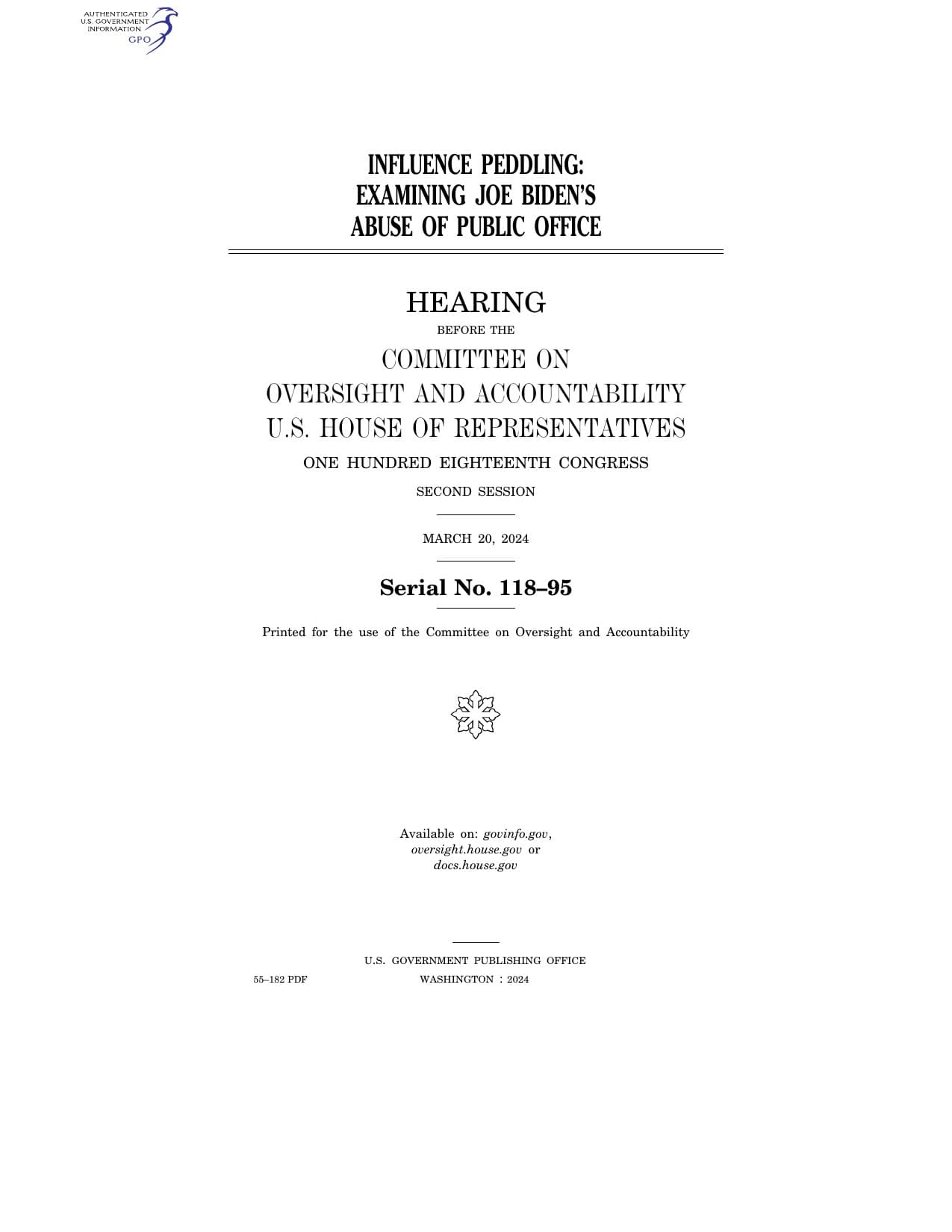
Public hearing  ·  March 20, 2024  ·  House Oversight Committee  ·  C-SPAN
"Say it, forget it.
Write it, regret it."
That was the practice.
This is the record.
How This Came to Be Public
Four steps. Each one a formal institutional act.
Feb 232024
Closed transcribed interview
Four hours. 127 pages. Federal Prison Camp, Maxwell AFB, Montgomery, Alabama. House Committees on Oversight and Judiciary. Representative Andy Biggs present.
Mar 52024
Transcript released. Witness protection letter sent.
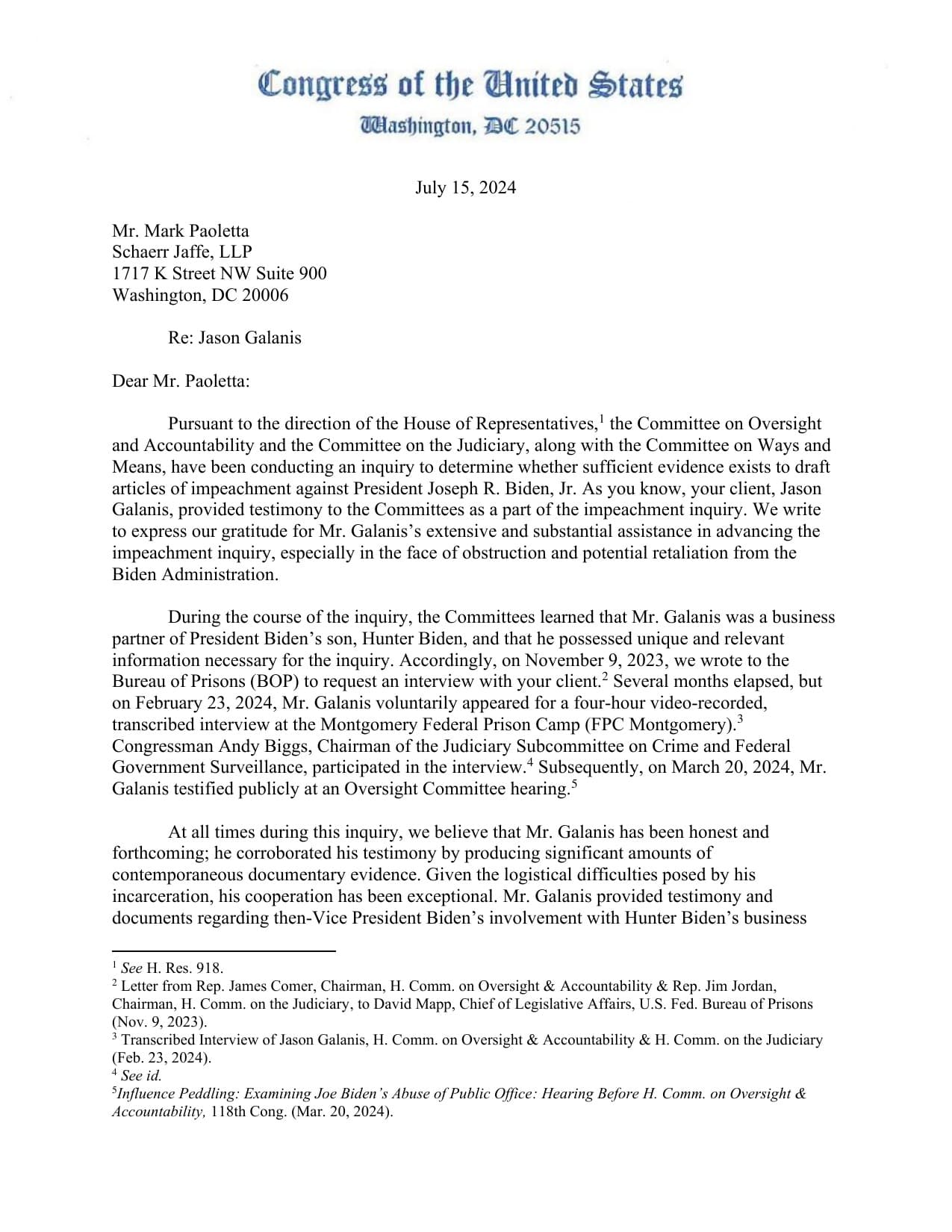
Comer and Jordan released the full transcript. Jordan, Comer, and Biggs simultaneously wrote to the BOP director and SDNY warning they would "take seriously any attempt to retaliate against witnesses."
Mar 182024
Chairman Comer writes to House Majority Leader Scalise
To allow a federal prisoner to testify remotely at a public hearing required the Majority Leader's written permission. Scalise granted it. Comer called the testimony "critical to both the impeachment inquiry and to further the Committee's legislative purposes."
"His testimony is critical to both the impeachment inquiry and to further the Committee's legislative purposes."
Chairman James Comer, letter to House Majority Leader Steve Scalise  ·  March 18, 2024
The Biden Lift
The term used in business. Defined under public questioning.
Transcript, p. 24  ·  Feb 23, 2024
Counsel
Can you just spell it out for us — what was the Biden lift?
Galanis
Foreign investors would have a view of political access to the most powerful, admired country in the world, leadership in the most powerful, admired country in the world.
 
Contacts we wouldn't be able to get on our own but for the Biden lift.
The Only Value
On Burisma. On national television.
Public hearing  ·  March 20, 2024  ·  Broadcast C-SPAN
Counsel
The only value that he's providing is that he's the son of the Vice President, correct?
Galanis
Yes.
Hunter Biden's Response
He told the committee he barely knew Galanis. The record says otherwise.
"I think that 10 years ago, for 30 minutes, I was introduced to Jason Galanis, and that's the only time I ever recall meeting him."
Hunter Biden, closed deposition  ·  House Oversight Committee  ·  February 28, 2024

The documentary record submitted to Congress — equity agreements delivering 100,000 shares of Burnham, an $800,000 annual salary as Vice Chairman and Managing Director, emails, and the Burnham-Harvest investor presentation listing Hunter Biden as executive leadership — directly contradicts that account. When asked about President Biden's denials of involvement in family business dealings, Galanis testified they were "misleading to the point of being an untruth."

The Record
Not commentary. Not interpretation.

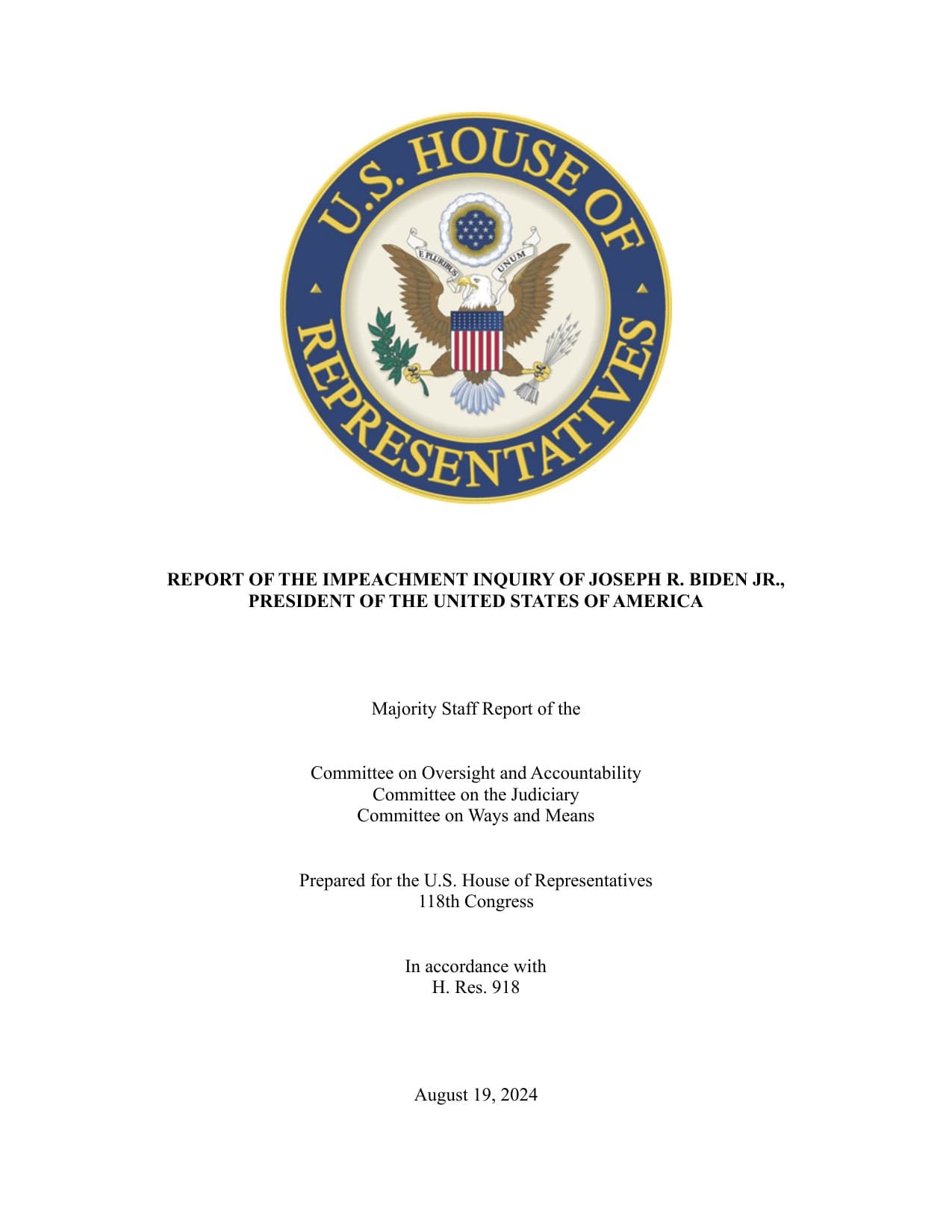
Closed transcribed interview, February 23, 2024. Transcript publicly released, March 5, 2024. Public hearing broadcast on C-SPAN, March 20, 2024. Written testimony submitted to the Congressional record, March 20, 2024. Cited more than 110 times in the final Biden impeachment inquiry report.

Pardoned by President Donald J. Trump, March 28, 2025.

Read the record.
Review the testimony.
Decide for yourself.

Watch on C-SPAN
The Hearing
March 20, 2024
House Oversight Committee
Washington, D.C.
"Influence Peddling: Examining Joe Biden's Abuse of Public Office"
Broadcast live on C-SPAN and national television
Testimony from federal prison  ·  Alongside Tony Bobulinski
Why This Matters
Congressional committees do not put witnesses on national television without first assessing their credibility.

The sequence is deliberate. The closed interview came first — February 23, 2024, four hours, 127 pages. Congress reviewed that record. Comer and Jordan released it publicly on March 5 and simultaneously sent a formal letter to the BOP and SDNY warning against witness retaliation. On March 18, Chairman Comer took the procedurally unusual step of writing to House Majority Leader Steve Scalise to request special permission for a federal prisoner to testify remotely at a public hearing.

That request required the Majority Leader's written sign-off — a step not taken lightly. Scalise granted it. On March 20, Galanis testified before the full committee, before cameras, before the American people.

"His testimony is critical to both the impeachment inquiry and to further the Committee's legislative purposes."
Chairman James Comer, letter to House Majority Leader Steve Scalise  ·  March 18, 2024
What Was Said Publicly
On the record. On camera. To the American people.
"The entire value add of Hunter Biden to our business was his family name and his access to his father, Vice President Joe Biden."
Jason Galanis  ·  Public testimony  ·  House Oversight Committee  ·  March 20, 2024
"To me, it was clearly set up ahead of time. It was an arranged call."
Jason Galanis, on the May 4, 2014 speakerphone call with Vice President Biden  ·  March 20, 2024
"Misleading to the point of being an untruth."
Jason Galanis, on President Biden's denials of involvement in family business dealings  ·  March 20, 2024
Who Did Not Appear
Hunter Biden was called. He did not testify.

Hunter Biden was called to appear before the committee on March 20, 2024. He did not. In his own closed deposition on February 28, 2024 — five days after Galanis testified in the closed session — he told the committee he had met Galanis only once, briefly, for thirty minutes, ten years prior. The documentary record submitted to Congress is inconsistent with that account.

Chairman Comer's Summary
Stated publicly at the hearing.
"It's done over and over again. The Biden family promises Joe's power, Joe Biden shows up, and millions of dollars come into the Bidens' pockets. Joe Biden is the Biden family's closer."
Chairman James Comer  ·  House Oversight Committee  ·  March 20, 2024
The Witness Protection Letter
Congress formally warned against retaliation. In writing. To the SDNY.

On March 5, 2024 — the same day the transcript was released — Jordan, Comer, and Biggs sent a formal letter to the BOP director and the U.S. Attorney's Office for the Southern District of New York. They stated they were investigating Galanis's allegations and would "take seriously any attempt by the Bureau of Prisons to obstruct the Committees' inquiry, including by retaliating against witnesses." That letter was addressed to the same SDNY office that had intervened to block his home confinement nine months earlier.

Watch on C-SPAN
The Structure
How it was built.
How it was described.
In the words used at the time.
Drawn from transcript and written testimony  ·  Feb–Mar 2024
The Biden Family Office
The phrase used internally. Testified to publicly.
"Burnham was the focal point for integrating a 'Biden Family Office' into a large-scale financial company with international influence."
Written testimony  ·  March 20, 2024

Hunter Biden served as Vice Chairman and Senior Managing Director of Burnham at an $800,000 annual salary — documented in a signed employment agreement dated April 16, 2015. His Washington advisory firms — RSP Investments and Rosemont Seneca Advisors — were acquired into the platform. Hunter Biden's failure to disclose this role in his own sworn congressional testimony became the subject of a formal criminal referral.

Employment Agreement  ·  Burnham Asset Management Corp. & R. Hunter Biden  ·  April 16, 2015
Role
"Burnham hereby hires the Employee, as Vice Chairman and Senior Managing Director, of Burnham. The Employee shall devote a majority and substantial portion of his business and professional time, attention and energy to the performance of the Duties on behalf of Burnham."
Salary
"The Employee shall receive an annual salary of $800,000 payable over the course of the year on the 15th and last day of each month."

Signed by Jon M. Burnham, CEO, and R. Hunter Biden, Employee. Burnham Asset Management Corp., 1325 Avenue of the Americas, 26th Floor, New York. Document on file with the House Oversight Committee.

The Harvest Partnership
$300 billion. CCP-connected. One reason for their interest.
"In my opinion, there was no other reason for this massive Chinese enterprise to have been interested in doing business with Burnham other than the Biden name."
Transcript, p. 10  ·  Feb 23, 2024

Harvest Chairman Henry Zhao sought continual reassurance that Joe Biden would join the Harvest board after the Vice Presidency. A July 2014 email submitted to Congress described the arrangement as the "creative idea" — and the source of "intangible goods" the partnership would provide. Jonathan Li of Bohai requested the partners' "political muscle" in writing before China had even approved the formation of BHR.

The Burisma Structure
The protection was the product. Confirmed under questioning.
Transcript, p. 95  ·  Feb 23, 2024
Counsel
Was it your understanding that Zlochevsky placed Hunter Biden on his board for protection?
Galanis
Yes.

Devon Archer wrote to a Middle Eastern royal family member that his contacts included the VPOTUS and that "Ukraine was in VPOTUS' portfolio." The "nonlegal protection" in the Burnham-Zlochevsky energy deal was described as "the relationship cover of DA and HB" — defensive against Zlochevsky's legal exposure, offensive for securing government ministry approvals.

An October 2015 email shows Archer forwarding an internal proposal describing precisely what that protection was expected to deliver:

Devon Archer email re Burisma proposal  ·  October 20, 2015  ·  Document on file, House Oversight Committee
Archer
"I think this might be a little too overt but this was the feedback below."
Target
"Us ambassador communicates to Ukraine officials i.e. President administration formally/informally that he/U.S. government is ok with NZ, supports him and Burisma. Other U.S. High ranking officials communicate this message to President Administration. President Administration and other agencies (general prosecutors office) do not pursue NZ. NZ freely travels home."

NZ refers to Mykola Zlochevsky, the Burisma owner. The proposal sought to deploy U.S. government influence — including the Ambassador — to shield him from prosecution and allow him to freely travel. Archer's own note: "a little too overt."

The May 4 Call
Speakerphone. Named witnesses. Calendar evidence. Sworn and public.
"To me, it was clearly set up ahead of time. It was an arranged call."
Jason Galanis  ·  Public testimony  ·  March 20, 2024

May 4, 2014. Romanoff's restaurant, Brooklyn. Hunter Biden called his father on speakerphone in the presence of Yelena Baturina, Yuri Luzhkov (former Mayor of Moscow), Devon Archer, and Galanis. The Vice President said something about "being helpful." Days later, Baturina committed to a $10–20 million investment in a Burnham banking client. Hunter's calendar entry confirming his attendance was entered into the Congressional record as Exhibit 8.

Was It Real
Perceived or actual — answered on the record.
Transcript, p. 97  ·  Feb 23, 2024
Counsel
Now was it a perceived political influence, or was it actual?
Galanis
It was real in the sense it caused people to do things that they otherwise wouldn't have done. So it's real.
The Retaliation
Three dates.
One sequence.
Documented in sworn testimony.
Transcript, pp. 13–15  ·  Feb 23, 2024
The Timeline
The sequence is in the record.
June 9, 2023
Home confinement approved in writingBureau of Prisons California staff confirmed approval to FPC Pensacola. Six years of good behavior. Minimum custody level.
June 12, 2023
Devon Archer subpoenaedHouse Committee on Oversight announces subpoena relating to Joe Biden's business dealings.
June 13, 2023
Approval reversedOne day after the subpoena. SDNY prosecutors intervened with Bureau of Prisons staff. The stated rationale changed at each stage of appeal.
The Appeals
The rationale changed at every stage.
Transcript, p. 14  ·  Feb 23, 2024
Galanis
First it was that there was too much time left on my sentence. This is not a valid reason for denial.
 
Next, it was that the CARES Act expired on May 10, 2023. This rationale is contrived and contradicted by the approval on June 9th, a date after the purported May 10th expiration.
 
The BOP policy is that all CARES Act applications submitted before May 10th were to be processed, which I witnessed firsthand with fellow inmates being released well into late summer. I was being treated differently.
Stated Risk — On the Record
Said to the committee. From inside a federal prison.
Transcript, p. 21  ·  Feb 23, 2024
Rep. Biggs
Even testifying here today, you have legitimate concerns about possible retaliation?
Galanis
Yes. As a ward of the Bureau of Prisons, I think I have concerns. There are mechanisms for retribution against inmates, including solitary confinement and other procedures that could be leveraged against me.
The Resolution
The DOJ did not relent. President Trump acted.
"I believe that, based on the events I've described, much of which is memorialized in writing, that I've been the victim of a pattern of retribution by the Department of Justice in order to prevent my home confinement, which would have allowed full and free access to congressional investigators."
Transcript, p. 15  ·  Feb 23, 2024

The home confinement reversal was never corrected by the Department of Justice. Pardoned by President Donald J. Trump, March 28, 2025.

The Escalation  ·  September 2024
Congress kept pushing. The BOP kept stonewalling. A contempt threat was issued.

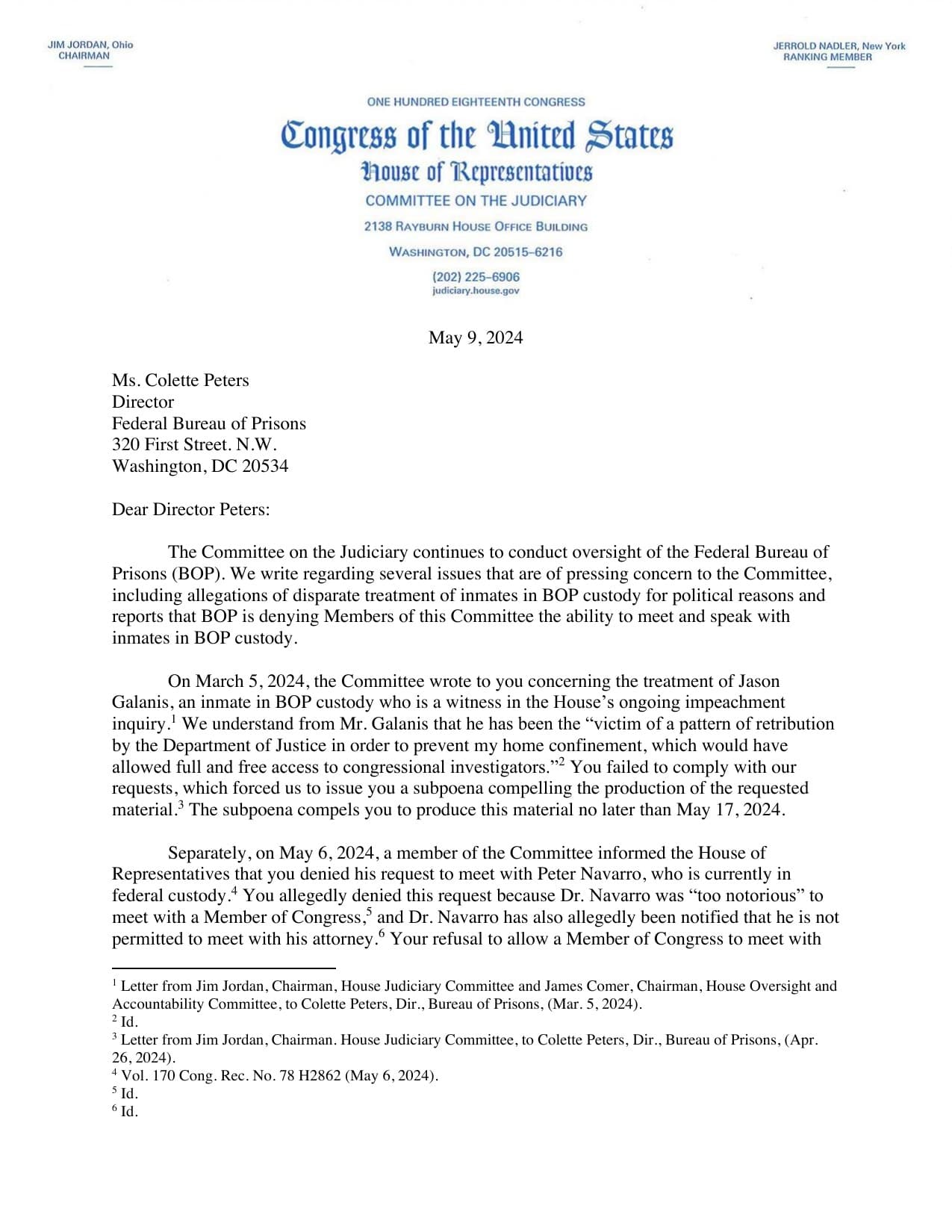
The investigation into the treatment of Galanis did not end with the July letter. The BOP Director, Colette Peters, testified before the Subcommittee on Crime and Federal Government Surveillance on July 23, 2024. Her testimony resolved nothing.

Jordan & Biggs to BOP Director Peters  ·  September 20, 2024
Congress
"Your testimony did not provide the Committee with all the information necessary for its investigation."
 
"You refused to answer basic questions from Members about that matter. For example, when asked whether the staff member who assaulted Mr. Galanis was still working for BOP, you declined to 'speak to the alleged individual's circumstances,' citing 'an ongoing investigation.'"
Contempt
"If you remain out of compliance with the Committee's subpoena, the Committee may consider taking further action, such as the invocation of contempt of Congress proceedings."
Mar 5, 2024
Letters to BOP and SDNYJordan, Comer, and Biggs demand documents. Warn against retaliation against witnesses.
Apr 26, 2024
Formal subpoena issuedJordan and Comer subpoena BOP Director Peters for three categories of documents related to Galanis's treatment.
Jul 23, 2024
BOP Director testifies — refuses to answerPeters declines to address the assault, the home confinement reversal, or the SDNY intervention. "An ongoing investigation."
Sep 20, 2024
Contempt of Congress threatenedJordan and Biggs formally warn Peters: comply with the subpoena or face contempt proceedings.

The same month this contempt threat was issued, Jason Galanis remained incarcerated. President Trump pardoned him six months later, on March 28, 2025.

House Judiciary Committee  ·  Select Subcommittee on the Weaponization of the Federal Government  ·  118th Congress  ·  Chairman Jim Jordan
Two things happened to Jason Galanis that the House Judiciary Committee determined warranted formal investigation, subpoenas, a contempt threat against a sitting agency director, and inclusion in a 17,019-page final report on the weaponization of the federal government.

The first was selective prosecution: Galanis was charged, convicted, and sentenced to 189 months for conduct the committee found was shared by Hunter Biden — who was never charged. The second was retaliation: when Galanis cooperated with Congress, the same federal apparatus that prosecuted him intervened to keep him incarcerated and isolated from investigators.

Both are documented. Both are part of the permanent congressional record.
This is not allegation. This is the official record of the 118th Congress.
"Mr. Galanis specifically alleged in his transcribed interview that he has been singled out for unequal treatment while in BOP custody after he asserted in a petition for commutation of his sentence that Hunter Biden and another business associate, Devon Archer, were complicit in the same illegal acts that landed Mr. Galanis in jail."
Jordan, Comer & Biggs  ·  Official letter to BOP Director Colette Peters  ·  March 5, 2024

Read the letter →
One Prosecutor. Three Decisions.
AUSA Negar Tekeei declined to charge Hunter Biden. She sentenced Jason Galanis to 189 months. She then threatened to go "hard on this" to keep him in prison when Congress came looking for him.

This is the thread that connects both dimensions of what happened to Jason Galanis. The same Southern District of New York prosecutor sits at the center of every significant decision: who got charged, what sentence was imposed, and who stayed in prison when a congressional subpoena arrived for his closest associate.

The House Judiciary Committee saw it the same way. When it launched its formal investigation, it sent letters simultaneously to the Bureau of Prisons Director and to AUSA Tekeei — treating them as two arms of the same institutional failure. It demanded transcribed interviews from both. When Tekeei did not respond, the committee escalated directly to her boss — US Attorney Damian Williams, head of the entire SDNY — and attached a subpoena to the letter. Williams also did not respond.

The record of non-compliance at every level — line prosecutor, agency director, US Attorney — is part of the official congressional file.

Part I  ·  The Selective Prosecution
Hunter Biden was "closely involved" with Burnham. He was never charged. Jason Galanis received 189 months. Devon Archer received one year. The committee found Galanis was singled out.

Burnham Financial Group was built by Jason Galanis, Hunter Biden, Devon Archer, and others as a platform intended to leverage Biden family political relationships — including Joe Biden's anticipated post-vice-presidency access — to attract Chinese sovereign capital through Harvest Fund Management. Galanis has testified to this under oath. It is part of the congressional record.

The Wakpamni bond transaction — the conduct for which Galanis was prosecuted — was carried out through the same platform, by the same principals. Hunter Biden was closely involved with Burnham throughout. According to Just the News's reporting on the committee's investigation, Hunter Biden "managed to avoid any scrutiny in the cases of both Galanis and Archer despite his close involvement with the company that perpetrated the scheme."

The SDNY, under Tekeei, did not charge Hunter Biden. It charged Galanis. It charged Archer. The sentencing outcomes that followed tell their own story.

Sentencing comparison  ·  Same scheme  ·  Same platform  ·  Same proceeding
Galanis
189 months  ·  Sentenced by Judge Castel, SDNY  ·  Prosecuted by AUSA Tekeei  ·  Served approximately 8 years before commutation
Archer
1 year and 1 day  ·  Initial sentence, Judge Abrams  ·  Same Wakpamni proceeding  ·  Subsequently received full presidential pardon
H. Biden
Not charged  ·  Despite close involvement with Burnham throughout the period in question  ·  SDNY declined to pursue

The committee's March 5, 2024 letter to Director Peters made the finding explicit: Galanis had been "singled out for unequal treatment" after asserting that Biden and Archer "were complicit in the same illegal acts that landed Mr. Galanis in jail." That language — "singled out," "same illegal acts" — is not Galanis's characterization. It is the Judiciary Committee's.

There is one further dimension. From the time of his guilty plea, Galanis offered the SDNY his cooperation — information about other parties to the scheme that could have led to additional indictments and, under standard practice, a reduction in his own sentence. The offer was rejected. The office that declined to charge Hunter Biden for his Burnham involvement also declined to hear what Galanis knew about him. Both decisions were made by the same office. Both decisions pointed in the same direction.

"Hunter Biden managed to avoid any scrutiny in the cases of both Galanis and Archer despite his close involvement with the company that perpetrated the scheme."
Just the News  ·  May 9, 2024  ·  Reporting on House Judiciary Committee investigation
Part II  ·  The Retaliation
When Galanis cooperated with Congress, the same SDNY office that prosecuted him intervened to reverse his approved home confinement — three days after Devon Archer was subpoenaed.

On June 9, 2023, the Bureau of Prisons approved Galanis's CARES Act home confinement request — a decision that had gone through the Pensacola warden, the California residential reentry office, and BOP staff over months of normal process. On June 12, the Oversight Committee issued a subpoena to Devon Archer. On June 13, Tekeei contacted BOP's Long Beach RRM. The April 26 congressional letter to US Attorney Williams, citing the transcribed interview directly, records what she said: she communicated her "strongest objection" and threatened to go "hard on this" to the BOP Director personally if the application went any further. The approval was reversed that day.

The committee documented a second suspicious timing event. On February 8, 2024, the Committees informed BOP they intended to interview Galanis. Three days later, BOP sent him its final denial of his home confinement appeal — dated January 4, more than a month earlier — held and released three days after Congress announced it was coming.

When Galanis appealed the original reversal, the stated reasons shifted at each stage: first, too much time left on his sentence; then, the CARES Act had expired. Both were invalid. The June 9 approval itself postdated the purported expiration. Fellow inmates were being released under the same program well into late summer. In his sworn words: "I was being treated differently."

The committee's finding was unambiguous. BOP's conduct "gives the appearance that BOP has targeted him for 'retribution' and is an effort to suppress his testimony about the Biden family's influence peddling scheme." That is the Judiciary Committee Chair, in writing, to a sitting federal agency director. It is a congressional finding, not a complaint.

"I understand from a former high-ranking Bureau of Prisons official that the SDNY prosecutors aggressively weighed in with the Bureau of Prisons staff to oppose my release."
Jason Galanis  ·  Transcribed interview, House Oversight Committee  ·  February 23, 2024
The Official Record  ·  In Sequence
Seven escalating actions by the House Judiciary Committee over nine months. Each one documented. None of them routine.
Mar 5, 2024
Simultaneous letters to BOP Director Peters and AUSA Tekeei. Jordan, Comer, and Biggs demand transcribed interviews from both — treating them as two sides of the same institutional conduct. The letter to Peters cites the home confinement reversal and the sexual assault. The letter to Tekeei demands she account for her office's role in opposing Galanis's release. Neither responds.

Letter to BOP Director Peters, Mar 5, 2024 →   Letter to AUSA Tekeei, Mar 5, 2024 →
Apr 26, 2024
Jordan and Comer write directly to US Attorney Damian Williams — head of the entire SDNY — and attach a formal subpoena. Having received no response from Tekeei or Peters, the committee escalates to Williams personally. The letter states the committees have received "additional information that strongly suggests the U.S. Attorney's Office for the Southern District of New York has been retaliating against Mr. Galanis for his cooperation." It documents Tekeei's "hard on this" threat in detail, citing the transcribed interview. A subpoena for SDNY documents is enclosed. Williams does not respond.

Letter & Subpoena to US Attorney Williams, Apr 26, 2024 →
Apr 26, 2024
Formal subpoena also issued to BOP Director Colette Peters. Simultaneously with the Williams letter, the committee issues a compulsory subpoena to Peters demanding all documents and communications related to Galanis — including all communications between BOP and the SDNY. Compliance deadline: May 17, 2024.

Follow-up letter to Peters, Jul 11, 2024 →
May 2024
Tekeei subpoenaed for transcribed interview. Wardens subpoenaed. After Tekeei "failed to respond" to the March letters, the committee issues separate letters to Tekeei, the current Pensacola warden, and the former Pensacola warden — all demanding transcribed interviews. Jordan and Biggs simultaneously pair the Galanis matter with the BOP's refusal to allow Congress to meet with Peter Navarro, framing both as a pattern of institutional witness isolation.

Subpoena to Tekeei, May 9, 2024 →   Letter to Warden Joseph →   Letter to Warden Saulsberry →
Jun–Jul 2024
Peters testifies but refuses to answer basic questions. BOP Director Peters appears before the Subcommittee but declines to answer direct questions about the sexual assault investigation and the CARES Act reversal. Jordan writes that her testimony "did not provide the Committee with all the information necessary for its investigation."

Follow-up letter to Peters, Jul 11, 2024 →
Sep 20, 2024
Jordan threatens contempt of Congress against the sitting BOP Director. Jordan formally warns Peters that continued non-compliance may result in contempt of Congress proceedings — a federal criminal referral against a sitting agency director. The threat is rare. The documentation supporting it, by this point, is extensive.

Judiciary Committee — Contempt Threat, Sep 20, 2024 →
Dec 2024
The 17,019-page final report of the Weaponization Subcommittee. The Select Subcommittee closes its work with a report documenting the full scope of federal government abuse across the 118th Congress. The Galanis case is included within the report's central finding: that the Biden-Harris administration operated "a two-tiered system of government — one of favorable treatment for the politically-favored class, and one of intimidation and unfairness for the rest."

Weaponization Subcommittee Final Report, Dec 2024 →
The Navarro Parallel
The committee explicitly paired the Galanis case with the Peter Navarro matter. Same agency. Same pattern. Same conclusion.

Peter Navarro, the former White House trade adviser, was serving a federal sentence concurrently with Galanis at FPC Montgomery. The BOP denied a Member of Congress's request to visit Navarro, stating he was "too notorious." Jordan, Biggs, and Gaetz cited this refusal in the same letter as the Galanis matter — making explicit the committee's conclusion that BOP was being operated as an instrument to isolate witnesses inconvenient to the Biden administration, regardless of which end of the political spectrum they occupied.

Two prisoners. Same agency. Same period. Same result. The committee called it a pattern, not a coincidence.

What the Subcommittee Found
"A two-tiered system of government." 17,019 pages. The permanent record of the 118th Congress.

The Select Subcommittee's December 2024 final report documented the Galanis case within its broadest finding: that the Biden-Harris administration systematically used federal agencies to protect political allies and punish those who posed an inconvenience to them. The sentencing disparity — 189 months for Galanis, one year for Archer, nothing for Hunter Biden — sits alongside the CARES Act reversal, the blocked in-person testimony, the BOP Director who declined to answer questions under oath, and the SDNY prosecutor who did not respond to a congressional subpoena.

Taken individually, each of these facts could be explained. Taken together — as the committee did — they form a documented record of institutional conduct directed at a single witness who had something to say about a politically protected family.

"For too long, the American people have faced a two-tiered system of government — one of favorable treatment for the politically-favored class, and one of intimidation and unfairness for the rest of American citizens."
Select Subcommittee on the Weaponization of the Federal Government  ·  Final Report  ·  December 2024  ·  17,019 pages
Why It Matters
The House Judiciary Committee is not a character witness. When it subpoenas an agency director and threatens contempt, it is because the evidence compelled it.

Selective prosecution — the decision to charge one participant in a scheme while declining to charge others who were equally involved — is among the most serious abuses a federal prosecutor can commit. It is not corrected by the courts in most circumstances. It is corrected by oversight. That is what the Judiciary Committee attempted to do here: put the SDNY's decisions on the public record, demand answers that were not given, and document the full pattern for the American people.

The record now exists. The letters are public. The subpoenas are filed. The contempt threat is documented. The 17,019-page report is the permanent record of the 118th Congress. None of it can be undone. None of it was created by Jason Galanis. All of it was created by the United States House of Representatives in response to what it found.

Read the record.
Review the testimony.
Decide for yourself.

The Documents
This is not Galanis describing the pattern.
This is Congress independently documenting it —
in a letter signed by two Committee Chairmen.
Comer & Jordan to SEC Chair Gensler  ·  June 18, 2024  ·  House Impeachment Inquiry
What the Letter Is
A formal congressional demand. Signed. Dated. In the record.

On June 18, 2024, Chairman James Comer and Chairman Jim Jordan wrote formally to SEC Chair Gary Gensler. The subject: the SEC's handling of Hunter Biden in connection with the tribal bond investigation — and whether that handling was consistent with equal application of the law. The letter was submitted as part of the House impeachment inquiry into President Biden.

Document 01
Hunter Biden's lawyers invoked the Vice President to discourage federal scrutiny.

When responding to an SEC subpoena in April 2016, Hunter Biden's counsel submitted 1,749 documents — and included this in their cover letter:

"We request that you treat this matter with the highest degree of confidentiality... it would be unfair, not just to our client, but also to his father, the Vice President of the United States, if his involvement in an SEC investigation and parallel criminal probe were to become the subject of any media attention."
Hunter Biden counsel's response to SEC subpoena  ·  April 20, 2016  ·  Cited in Comer–Jordan letter to Gensler  ·  June 18, 2024

Comer and Jordan's letter states directly: "Mr. Biden's response gratuitously invoked his father's position as the Vice President in what could be interpreted as an effort to discourage further SEC scrutiny."

Document 01-A  ·  Six Days Before
Hunter Biden's own partner was preparing a legal defense strategy against the same SEC investigation — in real time.

On April 14, 2016 — six days before Hunter Biden's lawyers sent the VP-invoking letter to the SEC — Eric Schwerin, Biden's business partner at Rosemont Seneca, wrote to Hunter Biden's legal team laying out their priorities for dealing with the investigation.

"Any time we spend between now and the 20th focused mostly on the main issues that the SEC and DOJ are concerned with — the emails, proof of payments out of RSB and talking points for your proffer."
Eric Schwerin, Rosemont Seneca Partners, to Hunter Biden's legal counsel  ·  April 14, 2016  ·  Document on file, House Oversight Committee

RSB is Rosemont Seneca Bohai — the same entity central to the congressional investigation and the tribal bond case. Schwerin's email confirms that on April 14, 2016, Hunter Biden's inner circle was actively preparing a proffer strategy and coordinating "talking points" for federal investigators. Six days later, his lawyers wrote to the SEC invoking the Vice President's name to request confidentiality. The SEC charged seven people. Hunter Biden was not among them.

Document 02
The SEC subpoenaed Hunter Biden. Charged seven people. Not him.

The SEC subpoenaed Devon Archer on March 14, 2016, Rosemont Seneca Bohai on March 11, and Hunter Biden on March 16. RSB — Hunter's entity — had purchased $15 million of the fraudulent tribal bonds. On May 11, 2016, the SEC charged seven individuals in connection with the scheme.

Hunter Biden was not among them.
SEC Press Release  ·  May 11, 2016  ·  Cited in Comer–Jordan letter  ·  June 18, 2024
Document 03
The attorney who led the investigation became Gensler's principal enforcement advisor.

Tejal D. Shah was the staff attorney who signed the subpoenas issued to Archer, Rosemont Seneca Bohai, and Hunter Biden. She subsequently became Gary Gensler's principal advisor on matters involving the Division of Enforcement — the most senior enforcement advisory position at the SEC. Comer and Jordan requested she be made available for a transcribed interview.

Document 04
Congress referred Hunter Biden for perjury and false statements. After telling the committee he barely knew Galanis.

On June 5, 2024 — signed by Comer, Jordan, and Jason Smith, Chairman of the Ways and Means Committee — Congress formally referred Hunter Biden to the Department of Justice for criminal prosecution under 18 U.S.C. § 1001 (false statements) and 18 U.S.C. § 1621 (perjury).

Among the false statements documented: Hunter Biden told the committee he had no knowledge of, affiliation with, or position at Rosemont Seneca Bohai — the same entity whose bank account purchased $15 million of the tribal bonds that formed the basis of the criminal case that sent Galanis to prison. Documentary evidence submitted to Congress proved otherwise. Hunter Biden had directed Burisma to wire his monthly fees into that account, signed a corporate resolution as its Secretary, and was a 50-50 equity owner.

"Hunter Biden and James Biden made provably false statements to the Oversight Committee and the Judiciary Committee about key aspects of the impeachment inquiry, in what appears to be a conscious effort to hinder the investigation's focus on President Joe Biden."
Criminal referral to AG Garland  ·  Comer, Jordan & Smith  ·  June 5, 2024

The referral also documented that Hunter Biden denied knowing Galanis — claiming he had met him only once, for thirty minutes, ten years prior. The documentary record submitted to Congress — equity agreements, salary arrangements, the Burnham-Harvest presentation listing Hunter Biden as executive leadership — is inconsistent with that account. Congress referred him for prosecution. He received a blanket pardon instead.

Why This Page Exists
Corroboration is not self-report.

The Record, The Interview, The Structure, and The Retaliation pages reflect Jason Galanis's sworn testimony. This page is different. The Comer–Jordan letter to the SEC, the criminal referral to the AG, and the congressional letters to the BOP and SDNY were all written independently by Committee Chairmen, submitted formally to federal officials, and entered into the Congressional record — without reference to anything Galanis said. The pattern they document is the same pattern described in testimony. The source is Congress.

Personal narrative  ·  Jason Galanis  ·  Written in custody
What Eight Years
Actually Looked Like

This page is not about the case. It is not about Congress or documents or testimony. It is about what happened to a man — and who he became on the other side of it.

Before We Begin
This is not a story about suffering. It is a story about what a person decides to do with it.

What follows is a description of eight years in federal custody — the facilities, the conditions, and one experience that I kept private longer than I should have. I am telling it now because context matters. Because the man who testified before Congress, who cooperated at personal cost, who chose to speak when silence was available — that man was shaped by what you are about to read.

I am not asking for sympathy. I accepted responsibility for what I did. I pleaded guilty. I served my time. What I am asking is that you understand the full weight of what that time actually was — not the version that fits in a sentencing memo, but the version that was lived. The back half of this page is about faith, about education, about who I intend to be. The front half is what made that choice necessary.

Read both halves together. That is the point.

The MCC
The Metropolitan Correctional Center, Manhattan. A facility later deemed unfit for human habitation and permanently closed.

I want to be precise about what federal custody actually means — because the word "prison" allows people to imagine something from their own experience. The Metropolitan Correctional Center in Lower Manhattan, where I spent my first sixteen months, was not a facility in the conventional sense. It was a structure that the federal government ultimately closed because conditions there were indecent. Judges said so. The Department of Justice, eventually, agreed.

I am not telling you this to invite sympathy. I am telling you because it is the factual starting place for everything that follows. What I went through was not a television version of incarceration. It was not sanitized. It was not safe. And it was not what most people — even those who visited — would wish on another person if they understood what it actually was.

I was not alone in that facility. I was surrounded by people for whom violence was not an abstraction. The kind that has nothing to do with white-collar sentencing guidelines or securities fraud. The kind that resolves you to decide, very quickly, who you intend to be under pressure. I learned things about myself in that building that I could not have learned anywhere else. I am not grateful for the conditions. But I am honest about what they produced.

MDC Brooklyn
Twenty-two months at the Metropolitan Detention Center. Eleven of them locked in a cell — for my own safety, they said — because of COVID.

From the MCC I was transferred to the Metropolitan Detention Center in Brooklyn. The MDC was not an improvement. It was a different category of failure — chronic, systemic, and well-documented by the time I arrived. The facility had already lost power for eight days during a polar vortex. Judges in both the Southern and Eastern Districts had begun reducing sentences, and in some cases refusing to send people there at all, purely on the basis of conditions. That is not advocacy. That is the judicial record.

Then COVID arrived. And for eleven months, I was locked in my cell. Not for misconduct. Not as punishment in any formal sense. For my safety, the Bureau of Prisons said. The door closed and it stayed closed. Eleven months.

I want you to understand what that means concretely. No programming. No movement. No work. No chapel. No human contact beyond what passed through a slot in a door. The BOP was not equipped for what happened — that is now established fact, not opinion. Inmates were dying. The psychological assault of watching people around you succumb to a disease while you sat in a locked cell, every day wondering if you were next, is not something a sentencing guideline anticipated. No court that sentenced anyone to federal custody in 2017 or 2018 or 2019 sentenced them to that.

Prison is supposed to be punishment. It is not supposed to be eleven months alone in a cell waiting to find out if a disease will finish what the sentence started.

I came out of that period a different person than I went in. I do not mean that as a redemption narrative. I mean it as a plain statement of fact. Eleven months of enforced solitude either breaks something in you permanently or builds something that was not there before. I chose to let it build.

The Assault
A member of the prison staff sexually assaulted me. I am a survivor. And I was believed.

This is the part I held back for the longest time — not from Congress, to whom I eventually disclosed everything, but from myself. From the instinct to minimize it. To rationalize it. To absorb it silently because disclosures felt more dangerous than what was being done to me.

Beginning in January 2023, a correctional officer at FPC Pensacola assaulted me. The harassment continued for months. I said nothing. The silence was decided by shame and by a calculation I am not proud of — I believed that speaking would make things worse. The Bureau of Prisons has a documented, terrible record on these matters. I knew it. Every inmate knows it. Officers are protected. Inmates are not believed.

In August 2023, when the threats became more direct and my fear for my physical safety outweighed everything else, I reported it through the chaplain. What followed — the warden's response, the PREA investigation, the transfer to Montgomery — I have testified to before Congress. I reported it despite the risk. And I am a survivor of it.

Shame would say silence. I decided I had been silent long enough about too many things.

In December 2024, following a year-long investigation, the Bureau of Prisons terminated Shannon Sullivan in connection with the sexual assault. The head of internal affairs supported the decision. I was believed. I want to be clear about how rare that outcome is — in a system that is structurally designed to protect officers and discount inmates, the investigation ran its full course and reached the right conclusion. That matters, not only for me, but for every person in federal custody who has stayed silent because they assumed no one would listen.

The matter does not end there. The Office of Legal Counsel at the Department of Justice has called on me to testify again in any prosecution that follows. I am prepared to do that. I am prepared to face my attacker in a proceeding, on the record, and say what happened. I have already said it under oath to Congress. I will say it again in whatever forum the law requires.

The Education
Eight years is either a sentence or an education. I chose education.

There is a moment — and I can tell you it does not arrive early, it does not arrive on schedule, and it does not announce itself — when you understand that everything that has happened to you is either going to define you or inform you. You can carry it as a grievance or use it as a foundation. I have watched men choose both paths. I have seen what each produces.

I was not prepared to self-immolate by retaining bitterness. This is not a spiritual abstraction. It is a practical position. Bitterness is a cell you build yourself, and I had spent enough time in cells that were built for me. I was not going to construct another one voluntarily and call it principle.

What I found in those years — in the most unlikely setting, through the most unlikely means — was faith. Not as a refuge from accountability. Not as a retroactive justification for choices I have already accepted responsibility for. Faith as something that arrived when I had exhausted every other framework for understanding what had happened to me and what I was supposed to do about it. It arrived quietly. It lasted.

I did not find God to escape what I had done. I found Him to understand what I was supposed to become because of it.
The Future
There is no version of the future that includes looking backward.

People expect survivors of sustained suffering to either perform their wounds or deny them. I intend to do neither. What happened to me happened. I have described it to Congress under a legal obligation to be truthful, and I stand by every word. But I do not hold it. I do not organize my days around it. The men and mechanisms that caused me harm are not taking up residence in my present tense.

That is a choice I made. It was not easy and it was not immediate. But it is the only position that makes sense if you want something beyond the main character act. Eight years of federal custody is either the worst thing that happened to me or the thing that made me who I intend to be. I cannot be both simultaneously. I have chosen the second.

The Promise
The experience will not be wasted. That much I can promise.

I testified before Congress because it was the right thing to do — and the one that came at the most personal cost. I am speaking now because the truth I have is no longer something I am willing to keep quiet about.

There is a two-tiered system of justice in this country. I know this not as a political position but as a lived fact. I watched it operate from the inside. I cooperated with the institution that jailed me. I cooperated — and was persecuted for it by the very institution I cooperated with. That is not a theory. That is a documented record.

President Trump recognized what happened and acted. I am grateful. Not because it vindicates me — the record does that — but because it demonstrates exactly what accountability is supposed to look like when a system has failed. What I want this to produce is simple: a record that is heard, a system that is examined, and proof that a man can go through the worst of what American institutional life can offer and come out the other side without surrendering the best of what he is. I have not surrendered it. I do not intend to.

I went in a capitalist. I came out a witness.
I intend to be useful in both capacities.
Jason Galanis
Closed interview — February 23, 2024
Public testimony — March 20, 2024 · House Oversight Committee · C-SPAN
Sentence commuted by President Donald J. Trump · 2025
Statement  ·  Jason Galanis  ·  2025
Why I'm Sharing This Now
For years, my story has been filtered through prosecutors, reporters, and political operatives. Those filters distort the facts, obscure the context, and omit the record when it's inconvenient. I am done with filters.
I  ·  The Record
What follows is not speculation. It is what I said under oath — twice.

On February 23, 2024, I gave a four-hour transcribed interview to the House Committees on Oversight and Judiciary at Federal Prison Camp, Maxwell AFB, Montgomery, Alabama. Congress reviewed that record. On March 5, they released the full transcript publicly and simultaneously sent a formal letter to the Bureau of Prisons and the SDNY warning against retaliation against me as a witness. On March 18, Chairman Comer wrote to House Majority Leader Steve Scalise requesting special permission for a federal prisoner to testify remotely at a public hearing — calling my testimony "critical to both the impeachment inquiry and to further the Committee's legislative purposes." Scalise granted it.

On March 20, 2024, I testified publicly before the full House Oversight Committee, broadcast on C-SPAN and national television, in the hearing titled "Influence Peddling: Examining Joe Biden's Abuse of Public Office." What the public did not know at the time — and what Chairman Comer later documented in his book All the President's Money — is that the Bureau of Prisons had agreed to allow me to testify in person. Four days before the hearing, the DOJ blocked it. I appeared by video from federal prison instead. Hunter Biden was called to testify in person. He did not appear. Devon Archer did not appear. I was never a Biden partisan. I was a capitalist who saw opportunity and acted on it. I am not asking anyone to take my word for it. The transcript exists. The written testimony exists. The hearing is on C-SPAN. Chairman Comer's book is on the shelves. Two Committee Chairmen independently documented the same pattern I described in a formal letter to the SEC Chair. I am asking people to read and watch all of it.

II  ·  Building Burnham
The platform. The scale. The decision I cannot undo.

My career was built in distressed debt and financial services. Over two decades, I acquired and built businesses — culminating in the acquisition of a $6.4 billion life insurance company in Europe. That business was pristine, regulated, and successful. It was never implicated in any allegation. I chose to combine it with U.S. assets. That decision was mine, and I own it fully.

Burnham & Company was the surviving division of Drexel Burnham Lambert — an 85-year-old Wall Street brand. Combined with affiliated insurance and wealth management businesses, the Burnham platform represented more than $17 billion in audited institutional assets. The ambition was to build something genuinely large — a diversified private equity enterprise capable of competing with the global titans of finance.

That ambition is what made me a target when things went sideways. I had assets worth controlling, a platform worth neutralizing, and a past that made me useful as a fall guy.

III  ·  The Biden Connection
What was offered. What was delivered. What the record shows.

In 2014, Burnham became Hunter Biden and Devon Archer's next vehicle after the collapse of their Rosemont partnership. I delivered 100,000 shares of Burnham — worth more than $30 million — to Hunter and Devon in exchange for what they called "relationship capital." Hunter did not bring capital. He did not bring financial expertise. His value, as I testified publicly before Congress, was his family name, his access to his father the Vice President, and the credibility that proximity to power confers.

Hunter Biden became Vice Chairman and Managing Director of Burnham at an $800,000 annual salary. When Hunter testified before the same committee, he told them he had met me only once, briefly, for thirty minutes. The documentary record submitted to Congress is inconsistent with that account. I called his denials "misleading to the point of being an untruth." I stand by that.

"The entire value add of Hunter Biden to our business was his family name and his access to his father, Vice President Joe Biden."
IV  ·  The Capitalist's Calculation
I was right about the asset. I was wrong about the men.

My decision to align with Hunter Biden and Devon Archer was not about politics or ideology. I was not a Biden loyalist then and I am not one now. I made a calculated business decision. I treated access to political power as a convertible asset — one that, properly structured, could translate into enterprise value at scale. That calculation was not wrong on its face. As I told Congress under oath: the influence was real in the sense that it caused people to do things they otherwise would not have done.

"I treated influence as an asset, believing it could be converted into enterprise value. I was right about the asset. I was wrong about the men."
V  ·  Two Tiers
What happened to me. What did not happen to them.

I pled guilty. I accepted punishment. I have expressed remorse, and that remorse is genuine. What I am asking people to look at is what happened next — because it is documented, dated, and in the Congressional record.

I offered the SDNY full cooperation at the time of my guilty plea — no reduction in charges requested. Rejected. Called highly irregular by my counsel. In 2018, senior SEC lawyers visited me in federal prison. They expressed interest. The U.S. Attorney's office quashed the scheduled follow-up, citing Brady concerns. And independently of anything I said, Chairmen Comer and Jordan documented that when Hunter Biden's lawyers responded to the SEC's subpoena in 2016, they invoked the Vice President's name in the cover letter — asking for confidentiality because scrutiny would be unfair to "his father, the Vice President of the United States." The SEC then charged seven people. Hunter Biden, whose entity had purchased $15 million of the fraudulent bonds, was not among them.

Congress called it what it was: a two-tiered system of justice. One standard for those with the right name. Another for everyone else.

On June 5, 2024, Congress formally referred Hunter Biden to the Department of Justice for perjury and false statements — signed by Comer, Jordan, and Jason Smith. Among the false statements: Hunter Biden told Congress he had no knowledge of, affiliation with, or position at Rosemont Seneca Bohai — the same entity whose bank account purchased $15 million of the tribal bonds at the center of the case that sent me to prison. Documents proved he had directed payments into that account, signed as its corporate secretary, and was a 50-50 equity owner. He also told Congress he barely knew me — once, thirty minutes, ten years ago. The record says otherwise.

Hunter Biden received a blanket pardon for all acts known and unknown, backdated eleven years — unprecedented in American history. The criminal referral was rendered moot. Devon Archer was sentenced lightly. I served eight years. That is the comparison. It does not require commentary.

VI  ·  June 13, 2023
One day. Documented.

June 9, 2023: home confinement approved in writing. June 12: Devon Archer subpoenaed by the House Oversight Committee. June 13: approval reversed. SDNY prosecutors had intervened with Bureau of Prisons staff. I appealed. The rationale changed at every stage. I testified about it before Congress while still inside a federal prison, knowing the risk. Congress sent a formal letter to the SDNY warning against retaliation against me as a witness. President President Trump pardoned me on March 28, 2025. I intend to use that freedom to ensure this record is heard.

VII  ·  Why It Matters Now
This is not history. The apparatus is still operating.

The DOJ that blocked my cooperation, reversed my home confinement, and quashed the SEC follow-up did not dissolve when the Biden administration ended. What changed is that there is now a President who has demonstrated — through his treatment of my case and others — that he will use the power of his office to correct what the system refused to correct itself. Pardons are individual acts. Reform is structural. The record I provided to Congress — and the record Congress independently compiled and submitted to federal regulators — is part of the evidentiary basis for that reform. That is why this site exists. That is why I am speaking.

Jason Galanis
Closed interview  ·  February 23, 2024  ·  Federal Prison Camp, Maxwell AFB
Public testimony  ·  March 20, 2024  ·  House Oversight Committee  ·  C-SPAN
Pardoned by President Donald J. Trump  ·  March 28, 2025
All the President's Money  ·  Chairman James Comer  ·  Broadside Books / HarperCollins  ·  2024
The Chairman of the House Oversight Committee wrote a book.
He devoted pages to Jason Galanis.
These are his words.
NYT Bestseller  ·  Pages 207–210  ·  James Comer, Chairman, House Committee on Oversight and Accountability
Why This Page Exists
This is not testimony. This is the Chairman speaking in his own voice — to the American public.

Every other page on this site draws from sworn congressional testimony, formal letters to federal regulators, or the public hearing record. This page is different. All the President's Money is Chairman James Comer's personal account of the Biden impeachment inquiry, published by HarperCollins in 2024. It became a New York Times bestseller. In it, Comer writes about Jason Galanis directly — what he witnessed, what he believes happened, and what he intends to do about it.

The source is the Chairman of the committee that conducted the inquiry. The publisher is HarperCollins. The words are his own.

Quote 01  ·  p. 207
The Chairman's personal admission.
"I also felt sorry for Galanis. Because of my investigation, he was denied home incarceration, raped in prison, and denied his awaited opportunity to set the record straight in person to a national audience."
Chairman James Comer  ·  All the President's Money  ·  p. 207

The Chairman of the House Oversight Committee states plainly that his investigation caused Galanis to be denied home confinement, assaulted in prison, and blocked from testifying before the American public in person. This is not an allegation by Galanis. This is the account of the man who ran the inquiry.

Quote 02  ·  p. 207
The DOJ blocked in-person testimony. Documented by the Chairman.
"Four days before the hearing we received a call back from the bureau declaring that the DOJ had blocked their request to allow Galanis to testify in person."
Chairman James Comer  ·  All the President's Money  ·  p. 207

The Bureau of Prisons had agreed to allow Galanis to testify in person before the full committee. Four days before the March 20, 2024 hearing, that permission was blocked — by the Department of Justice. Comer documents this directly. It is consistent with the sworn testimony Galanis gave about the June 2023 home confinement reversal.

Quote 03  ·  p. 210
The hearing. Who showed up. Who didn't.
"No Hunter Biden. No Devon Archer. Just stalwart Tony Bobulinski (and poor Jason Galanis via video) willing to testify openly."
Chairman James Comer  ·  All the President's Money  ·  p. 210

Hunter Biden was called to testify publicly on March 20, 2024. He did not appear. Devon Archer did not appear. Galanis testified remotely from federal prison — the only option available to him after the DOJ blocked his in-person appearance. The Chairman's characterization of who showed up and who didn't is his own.

Quote 04  ·  p. 207
The assault. The Chairman's account.
"Galanis testified that he was sexually assaulted by a prison guard. This sexual assault lasted until August 2023, when the chaplain for the prison intervened… The details of the sexual assault and subsequent constant harassment were horrific and difficult to listen to."
Chairman James Comer  ·  All the President's Money  ·  p. 207

This is documented in both the sworn congressional transcript and in the Chairman's published account. Galanis testified to Congress about the assault while still incarcerated, knowing the risk of doing so. Comer describes listening to that testimony directly.

Quote 05  ·  p. 207
The promise. In print. Under his name.
"I worry about other unthinkable consequences Galanis might face as a result of my investigation. One day I hope to find whoever did this to the guy and make their life extremely uncomfortable. It's the least I can do."
Chairman James Comer  ·  All the President's Money  ·  p. 207

The Chairman of the House Oversight Committee — in a book published by HarperCollins, bearing his name, sold in every major bookstore in America — acknowledged that what happened to Galanis happened because of his investigation, and committed to holding accountable whoever was responsible. That is the public record. It stands on its own.

Read the record.
Review the testimony.
Decide for yourself.